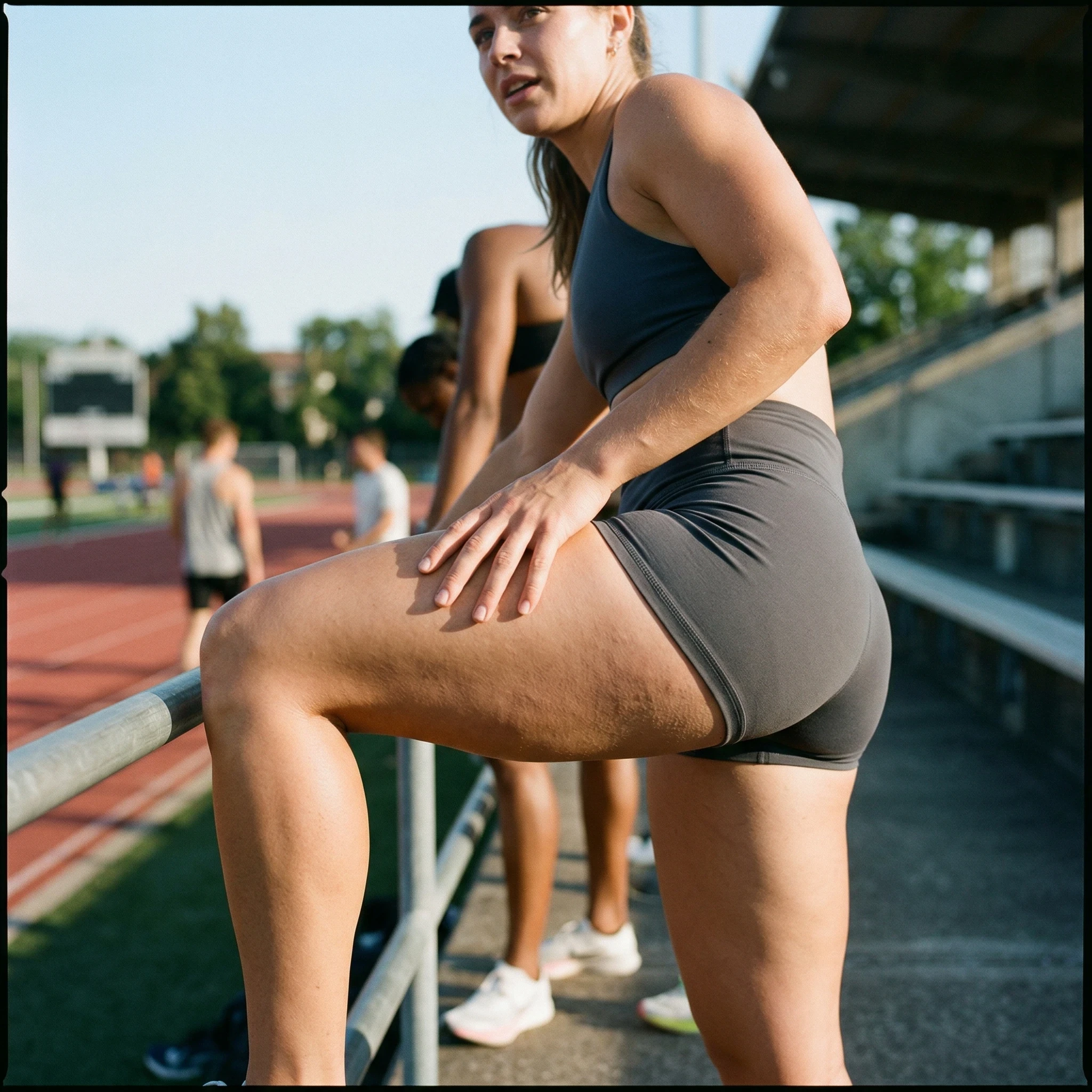
Most people assume cellulite means you are out of shape. That assumption falls apart the moment you look at real athletes. I still remember watching a pro-level sprinter at a track meet, quads like marble, bending over to tie her sneakers, and there it was: cellulite. Cellulite in athletes is far more common than most people realize, and if you have ever wondered why fit people have cellulite at all, despite training hard and eating well, the answer is not what most expect.
Cellulite is not a fitness problem. It is a structural one.

The Athlete Cellulite Paradox: Why Fit People Still Have It
Seeing cellulite on a toned, strong woman throws a wrench into everything pop culture tells us about bodies and fitness. The reality is that cellulite in athletes is not a dirty secret or a sign of poor health. It shows up across every fitness level, and it sometimes becomes more visible when body fat drops very low, because there is simply less tissue between the connective bands and the skin. You will spot it on Olympians, fitness influencers, and professional dancers, whether they are sprinting, deadlifting, or stepping offstage after a competition.
What Is Cellulite? A Quick Reality Check
Cellulite is not a disease, a toxin buildup, or the result of not training hard enough. According to the Cleveland Clinic, it is regular fat stored beneath the skin pressing up against a web of connective tissue bands, sometimes described as a net or mesh just under the surface. Where those bands pull downward and fat pushes up, you get the dimpling or bumpy texture often compared to an orange peel.
The key point: cellulite is mostly about how your connective tissue is structured, and only partly about how much fat you actually carry.
Why Athletes Still Get Cellulite: The Real Causes
Genetics Rule the Game
This is the biggest factor, and it is the one most people would rather not hear. The arrangement of your skin, fat layer, and connective tissue bands is largely inherited. Some people have thicker skin or tighter connective tissue weaving, which makes cellulite far less visible. Others, even with very low body fat, will always see some dimpling under certain lighting or when sitting down. If every woman in your family has cellulite, the odds are strong that you will too, regardless of how hard or how consistently you train.
The Hormone Connection: Estrogen’s Role
Why is cellulite so much more common in women? Estrogen. This hormone encourages fat storage in the thighs, hips, and glutes, which is exactly where cellulite tends to show up most. Estrogen also affects the strength and elasticity of those connective tissue bands, a link explored in peer-reviewed research on the etiopathogenesis of cellulite. Even elite runners and gymnasts with very low overall body fat often retain a fat layer in these areas regardless of how disciplined their training is. Men do get cellulite too, but far less visibly, because their connective tissue is differently arranged and their fat storage patterns differ.
Skin and Muscle Are Two Separate Layers
What most people do not realize is that building muscle does not pull the skin tight in a way that erases dimples. Skin sits above both fat and muscle, separated by those connective tissue bands. A powerful, well-developed leg does not automatically mean a smooth outer surface. Stronger muscles can create a firmer overall shape, which may reduce how obvious cellulite looks, but muscle development cannot change the actual structure of your skin.
Even Athletes Need Body Fat
You cannot eliminate all body fat and stay healthy. Even professional athletes need a baseline amount for hormone regulation, energy reserves, joint cushioning, and brain function. While carrying less fat reduces the volume pressing against connective tissue, just a few millimeters is enough to produce visible cellulite if your skin is thin or your connective bands are loosely arranged.
Circulation, Training Load, and Fluid Retention
After intense training sessions or during heavy training blocks, it is common to notice puffiness or more visible dimpling. That happens because hard exercise creates small amounts of inflammation in muscle tissue, which causes temporary fluid retention around skin and fat cells. For some athletes, this is enough to make cellulite look more pronounced for a few hours or even a full day. This is a normal part of recovery, not a sign that anything has gone wrong.
Why Even Athletes Get Cellulite (Quick Summary)
• Genetics determine how your connective tissue is arranged, which has more influence on cellulite than fitness level does.
• Estrogen promotes fat storage in the thighs, hips, and glutes, the primary cellulite zones for women.
• Even at low body fat, a small baseline amount of fat is always present, and that is enough for cellulite to show.
• Skin structure and muscle are separate layers; building muscle does not change the skin above it.
• Temporary fluid retention from hard training can make cellulite look more pronounced after workouts.
• Hormonal fluctuations throughout the month can also affect how visible cellulite appears day to day.
Why Exercise Alone Does Not Erase Cellulite
This is where expectations usually go wrong. It is natural to assume that consistent training will eventually burn off all traces of cellulite, but the biology does not work that way. Losing body fat can make dimpling less obvious, and building muscle creates a firmer, smoother-looking shape overall, but neither changes the underlying connective tissue structure.
Any program claiming to eliminate cellulite in a few weeks is skipping over genetics, hormones, and skin structure entirely. Cardio, strength training, HIIT, all of it is excellent for your health, body composition, and confidence. None of it will make all cellulite disappear permanently, and that is not a failure of the program or of you.
You can be in the best shape of your life and still have cellulite. That is not a contradiction. That is normal.
Does Being Fit Help at All?
In practice, yes. Being active usually means less overall fat, better muscle tone, and improved circulation, all of which can make cellulite less noticeable. It may fade in certain positions or under less direct lighting. But I have seen plenty of athletes with defined abs and sculpted legs who still have visible dimpling when their skin compresses or the light hits a certain angle. How much cellulite shows is not purely a fitness question. It comes down to your own unique skin and connective tissue, which no amount of training can fully override.
What Actually Works: How to Reduce Cellulite Naturally
Strength Training (Focus on Glutes and Legs)
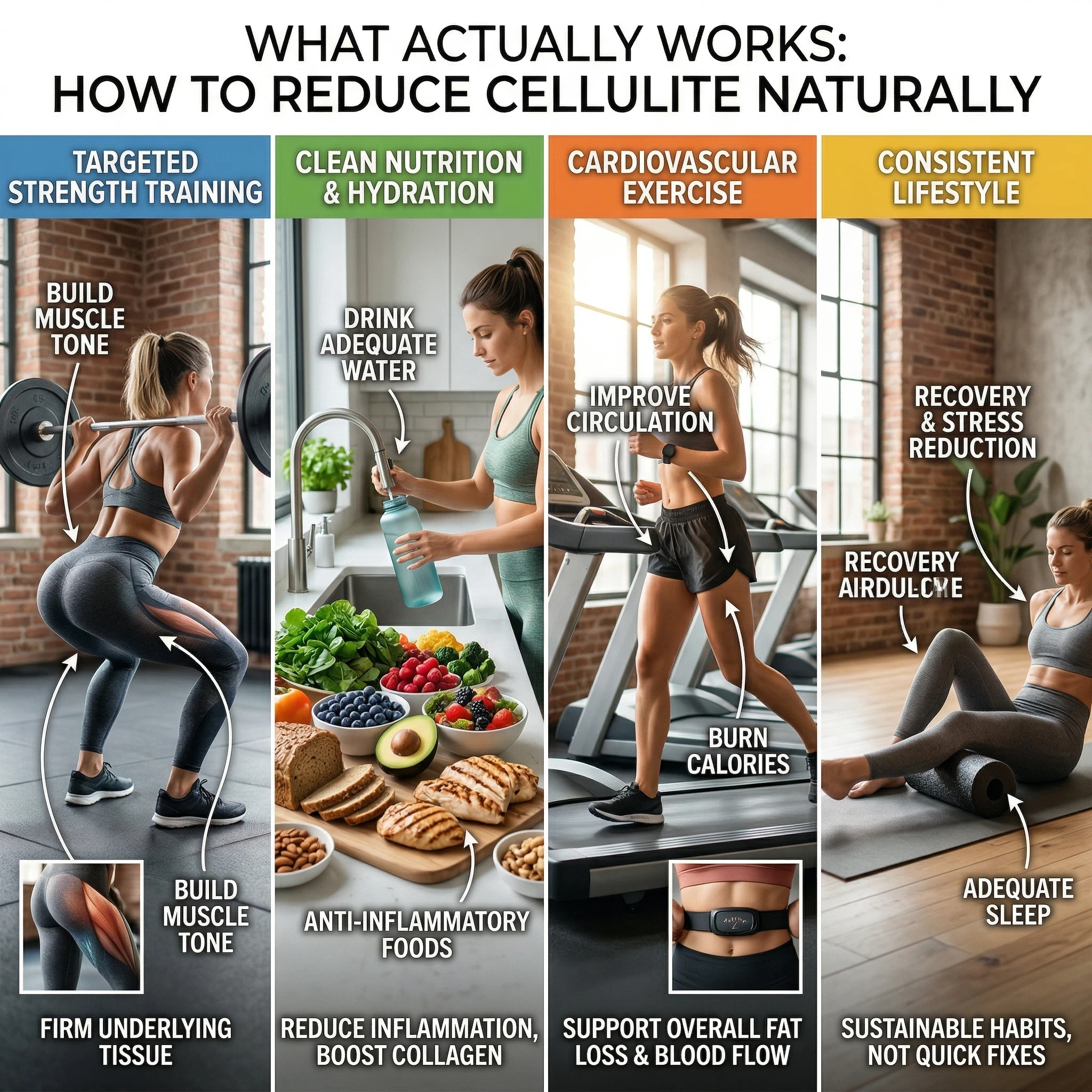
Resistance training, particularly exercises targeting the glutes and legs, is probably the single most effective tool available. Hip thrusts, squats, lunges, and Romanian deadlifts build muscle density beneath the skin, which creates a firmer shape overall. This does not fix the connective tissue, but it changes what is underneath it, and that matters. Research summarized by Medical News Today suggests that combining strength work with aerobic activity offers the best chance of visibly reducing dimpling over time. Adding variety through plyometrics or resistance band work keeps development progressive and helps with the overall shape and support under the skin. Consistent lower body training is the lever that actually moves the needle here.
Smart Nutrition and Hydration
A diet high in protein, healthy fats, and antioxidants supports both skin quality and muscle development. Staying well-hydrated keeps skin plumper, which makes dimples look shallower. Cutting back on added sugar and excess sodium reduces water retention and bloating day to day, which genuinely shows. Balanced eating will not erase cellulite, but it creates the best conditions for it to be as subtle as possible.
Improving Skin Quality
Collagen supports skin firmness and elasticity. Eating vitamin C-rich foods like bell peppers, oranges, and strawberries helps your body produce its own, which is more effective than most supplements. Retinol creams and caffeine-based topicals offer real but temporary surface smoothing, and the American Academy of Dermatology notes that these ingredients can modestly improve how the skin looks with consistent use. They do not fix the underlying structure, but consistent use alongside gentle exfoliation and moisturizing can improve how the skin looks from day to day.
Boosting Circulation: Foam Rolling and Massage
Foam rolling, dry brushing, and lymphatic massage improve blood flow and help reduce trapped fluid around the skin. The effects are real but temporary, so they work best as a regular habit rather than an occasional fix. Using these tools after hard training also supports muscle recovery, which is a good enough reason to build them into your routine regardless of cellulite.
Advanced Treatments (Optional)
Laser devices, radiofrequency machines, and acoustic wave therapy are available for those who want to explore further options. Some people see genuine improvement. These treatments can help retighten skin or slightly reduce localized fat pockets, but they are expensive, and results are partial and not permanent. Always research your provider carefully and go in with realistic expectations. These are not quick fixes but can be part of a longer-term approach if you want to try everything available.
Common Cellulite Myths Worth Dropping
Spot reduction: Targeting one area with exercise or body wraps does not selectively reduce cellulite there. That is not how fat loss works, and no amount of wishful thinking changes the physiology.
Endless cardio: Hours of running or cycling have not erased cellulite from professional athletes. If that were the solution, it would have worked for them already.
Miracle creams: No topical product eliminates cellulite. Some can smooth the surface temporarily, which is fine for a confidence boost, but it is not a fix and treating it like one leads to frustration.
The Psychological Side: What Social Media Gets Wrong
There is a version of fitness content online that has quietly convinced a lot of women that a smooth, dimple-free body is the baseline for being in shape. It is not. The images you see on social media are lit, angled, filtered, and often edited beyond recognition. Even the athletes and influencers who look flawless in those posts have cellulite in real life. Many of them talk about it openly in their behind-the-scenes content, which is worth seeking out if you find yourself comparing your body to their feed.
The expectations being placed on women, especially fit, athletic women, are genuinely unrealistic. Chasing a skin texture goal based on curated images is exhausting and, more to the point, it is not achievable through training. What tends to happen when people stop fixating on that specific thing is that they actually enjoy fitness more, because the focus shifts to performance, strength, and health rather than how skin looks under direct lighting.
Normalizing the real appearance of strong bodies is not about settling. It is about directing your energy toward things that genuinely respond to effort rather than things that largely do not.
Strength, Health, and a Realistic Finish Line

Fitness and cellulite can absolutely coexist. Training hard, eating well, and building muscle all help, and for many people they do make a visible difference. But genetics, hormones, and skin structure mean that some degree of cellulite is simply part of how most women’s bodies are built. That is not a failure. It is biology.
The shift that actually makes a difference is not a new workout program or a better cream. It is deciding that what your body can do matters more than what it looks like in an unflattering photo. Your strength, your endurance, your consistency over time, those are the things worth measuring.
If you want to actually improve how your skin looks rather than guess at what might work, start with our guide on how to reduce cellulite naturally, which covers practical, evidence-based strategies in real detail. If weight loss is part of your current picture, the breakdown of how weight loss affects cellulite is worth reading before you set your expectations. Either way, you now understand what you are actually dealing with, and that puts you well ahead of most of the advice out there.
Leave a Reply